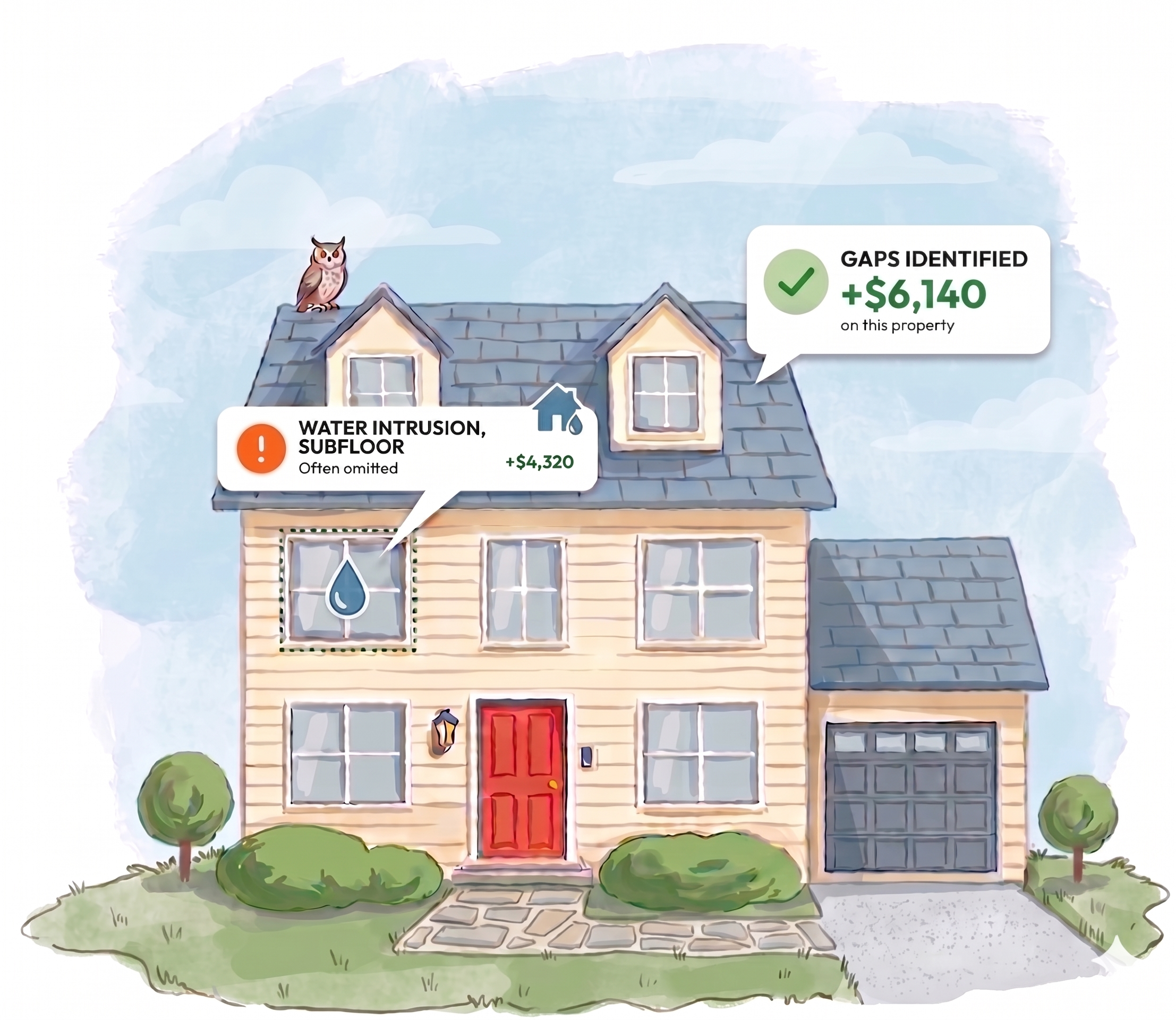
Have an active or pending home insurance claim?
See What Your Insurance Claim May Be Missing
Upload a few photos and we'll show you exactly what your repairs should cost at current market rates, so you can make informed decisions about your claim.
Free to get started.

Why I Built ClaimOwl
When our home experienced severe damage, the insurance company offered to pay a fraction of what we were actually owed. Like most homeowners, I had no idea what to look for. The estimate was full of confusing terminology, depreciation holdbacks, line items I couldn't verify, and scope decisions I didn't know I could question. I didn't know which items were undervalued, what materials needed to be matched, or what building codes required them to cover.
Through research and the right tools, we were able to achieve a full recovery, more than $30,000 above the original offer. That experience changed my perspective entirely. Most homeowners accept the first number they're given because the process is deliberately opaque. Terms like "ACV," "O&P," and "like-kind-and-quality" are designed for industry insiders, not homeowners.
I built ClaimOwl to cut through that confusion. Upload your photos, answer a few questions, and we'll translate everything into plain language with real market pricing, so you can see exactly what your repairs should cost and where your estimate may fall short.
Kevin Fleming
Founder, ClaimOwl
We identify the areas most commonly missed or undervalued in insurance estimates, and give you the information and market pricing you need to understand your claim's true value.
Scope Analysis
Items your adjuster may have missed or undervalued in the initial estimate.
Materials & Quality
Replacements must match the quality and grade of what was originally installed.
Code Compliance
Repairs that trigger current building code upgrades your insurer must cover.
Matching Requirements
Adjacent areas that need updating when damaged surfaces are part of a continuous set.
Hidden Damage
Water behind walls, mold under flooring, smoke in HVAC that visible clues point to.
Depreciation Recovery
Depreciation withheld from your initial payout that's recoverable after repairs.
Line Item Pricing
Unit prices and quantities verified against industry-standard estimating tools.
Consequential Damage
Secondary damage caused by the original event that adjusters often overlook.
Subfloor & Structural
Damage beneath visible surfaces that's frequently omitted from initial scope.
Appliance Handling
Disconnect, storage, and reconnect labor for appliances during restoration.
Contents Pack-Out
Professional removal, storage, and return of belongings during construction.
Overhead & Profit
Industry-standard O&P markup for projects involving three or more trades.
Additional Living Expenses
Temporary housing and meal costs when your home is uninhabitable during repairs.
Plumbing & Electrical
Full system assessment beyond just the failed component, including code upgrades.
Paint & Texture Matching
Full-room painting required for color consistency, not just patched areas.
Mold Assessment
Testing and remediation scope for mold caused by water intrusion events.
Trim & Millwork
Door casings, window trim, and crown molding that can't be reused after removal.
Permit & Inspection Fees
Required permits and inspections for electrical, plumbing, and structural work.