
Sample Report
Kitchen & Dining Room Water Damage Analysis
123 Oak Lane, Naples, FL, 34102
Water damage · Kitchen + Dining Room
Property Analysis Summary
2,400 sq ft single-family home built in 2008 with mid-to-premium grade finishes. The property sustained significant water damage from a kitchen supply line failure beneath the sink. Water spread across the kitchen floor and into the adjacent dining room through a shared open floor plan. Damage includes complete saturation of hardwood flooring across both rooms, water intrusion into lower cabinetry and island, warped baseboards, moisture behind drywall, and compromised subfloor. The scope of this analysis covers a full kitchen restoration and dining room hardwood floor replacement.
Cost Breakdown by Area
Kitchen
$28,350 - $50,040
13 items
Dining Room
$5,360 - $8,408
4 items
General
$7,500 - $17,300
4 items
$13,740
$75,748
+$62,008
Are Your Materials Being Undervalued?
Insurance estimates often use pricing for basic, builder-grade materials. If your home has higher-quality finishes, the realistic cost to replace them is higher. This table shows the gap.
Likely Offer is what a standard estimate typically includes for this item.
Realistic Cost is based on what we identified in your photos, which may be higher quality.
The Difference is the potential gap you may be able to recover.
| Item | Likely Offer | Realistic Cost | Difference |
|---|---|---|---|
| Hardwood flooring | $2,100 - $3,000 | $4,200 - $6,000 | +$3,000 |
| Lower cabinetry | $1,800 - $3,000 | $5,400 - $9,600 | +$6,600 |
| Kitchen island | $1,500 - $2,500 | $4,000 - $8,000 | +$5,500 |
| Granite countertops | $1,750 - $2,500 | $3,250 - $5,500 | +$3,000 |
| Tile backsplash | $300 - $480 | $540 - $900 | +$420 |
| Total | +$18,520 |
Kitchen 13 items found
| Item | Rate | Likely Offer | Realistic Cost | |
|---|---|---|---|---|
| Hardwood flooring — site-finished white oak, 5" plank, select grade, natural finish | $14-$20 per sq ft installed and finished | $2,100 - $3,000 | $4,200 - $6,000 |
Commonly estimated as pre-finished or engineered ($7-10/sq ft) rather than site-finished solid hardwood Site-finished requires sanding, 3 coats polyurethane on-site. 5" wide plank in select grade is premium.
|
| Upper cabinetry — semi-custom shaker, maple, soft-close Blum hinges | $350-$600 per linear foot installed | Usually not included | $3,500 - $6,000 |
Upper cabinets frequently excluded from scope when only lowers are water-damaged, but matching requirement may apply If lower cabinet manufacturer or finish is discontinued, uppers must also be replaced for visual consistency.
|
| Lower cabinetry — semi-custom shaker, maple, dovetail drawers, soft-close | $450-$800 per linear foot installed | $1,800 - $3,000 | $5,400 - $9,600 |
Commonly estimated at stock cabinet pricing ($150-250/ft) rather than semi-custom grade with dovetail joinery Dovetail drawer boxes and Blum hardware indicate semi-custom. Interior organizers and pull-outs add $50-150 per cabinet.
|
| Kitchen island — custom built-in with prep sink, electrical, and seating overhang | $4,000-$8,000 for comparable custom island | $1,500 - $2,500 | $4,000 - $8,000 |
Islands with plumbing and electrical are frequently estimated as simple cabinet runs rather than custom installations Includes prep sink plumbing, dedicated electrical circuit, countertop overhang with support brackets, and cabinet matching.
|
| Granite countertops — Level 3, ogee edge, undermount main sink + island prep sink | $65-$110 per sq ft fabricated and installed | $1,750 - $2,500 | $3,250 - $5,500 |
Edge profile and granite level frequently estimated at builder-grade (Level 1, eased edge) Two undermount sink cutouts required. Ogee edge is $15-25/linear ft vs $5-10 for eased. Slab matching across perimeter and island is critical.
|
| Tile backsplash — subway tile, 3x6, herringbone pattern with accent strip | $18-$30 per sq ft installed | $300 - $480 | $540 - $900 |
Herringbone pattern labor is 40-60% more than standard stack or running bond but is frequently estimated at standard labor rates Pattern matching and accent strip add complexity. Demolition of existing backsplash required before new installation.
|
| Subfloor — 3/4" tongue-and-groove plywood, water-saturated | $4-$7 per sq ft for removal and replacement | Usually not included | $1,200 - $2,100 |
Subfloor replacement is one of the most commonly omitted items in water damage estimates Saturated plywood delaminates even after drying. Moisture content must be below 12% before new flooring installation.
|
| Appliance disconnect, storage, and reconnect — refrigerator, dishwasher, range, microwave | $200-$400 per appliance | Usually not included | $800 - $1,600 |
Appliance handling labor is frequently omitted from initial estimates Includes disconnect, temporary storage during construction, and reconnect. Gas range requires licensed plumber for gas line disconnect/reconnect.
|
| Plumbing — supply line replacement, shut-off valves, P-trap, disposal reconnect | $600-$1,200 for complete under-sink plumbing | $150 - $300 | $600 - $1,200 |
Plumbing scope frequently limited to the failed line rather than full under-sink assessment Current code requires quarter-turn shut-off valves, braided stainless supply lines. Disposal and dishwasher drain connections included.
|
| Electrical — GFCI upgrades, under-cabinet lighting, island circuit | $150-$300 per outlet/circuit | Usually not included | $900 - $1,800 |
Code-required GFCI upgrades on exposed receptacles are frequently not included in scope NEC 210.8 requires GFCI within 6 ft of water source. Under-cabinet lighting wiring exposed during demo must be brought to code.
|
| Drywall — removal and replacement of moisture-damaged sections | $3-$5 per sq ft including tape, mud, texture, prime, and paint | $300 - $600 | $900 - $1,500 |
Spot repair commonly scoped rather than full-wall refinishing needed for consistent texture and paint Full-wall paint matching typically required. Texture must match existing pattern across entire wall surface.
|
| Painting — full kitchen walls and ceiling after drywall and cabinet replacement | $3-$5 per sq ft for walls; $2-$4 per sq ft for ceiling | $400 - $800 | $1,800 - $3,600 |
Painting scope is frequently limited to repaired areas rather than full-room for color consistency Paint matching on aged walls creates visible patches. Full-room painting is standard practice for consistent appearance.
|
| Baseboard and crown molding — stain-grade oak, 5.25" base + 3.5" crown | $10-$18 per linear ft for base; $8-$14 per linear ft for crown | $350 - $560 | $1,260 - $2,240 |
Crown molding commonly omitted from scope. Stain-grade estimated as paint-grade MDF ($3-5/ft) Stain-grade requires wood selection, stain matching, and clear coat. Crown must be removed for cabinet installation and may not survive removal.
|
| Room Total | $8,650 - $13,740 | $28,350 - $50,040 |
Dining Room 4 items found
| Item | Rate | Likely Offer | Realistic Cost | |
|---|---|---|---|---|
| Hardwood flooring — continuous with kitchen, site-finished white oak, 5" plank | $14-$20 per sq ft installed and finished | Usually not included | $2,800 - $4,000 |
Matching requirement for continuous flooring frequently not included in initial estimates Open floor plan with no transition between kitchen and dining room. Partial replacement creates visible seam. Full refinish or replacement of continuous area is industry standard.
|
| Subfloor — moisture migration from kitchen through shared floor plane | $4-$7 per sq ft for removal and replacement | Usually not included | $800 - $1,400 |
Dining room subfloor damage from kitchen water migration is commonly not included in initial scope Water travels along subfloor grain and through T&G joints. Dining room subfloor may appear dry on surface but retain moisture underneath.
|
| Baseboard trim — stain-grade oak, 5.25" colonial profile | $10-$18 per linear ft installed, stained, and sealed | Usually not included | $560 - $1,008 |
Dining room baseboards frequently excluded from scope even when flooring is replaced Baseboards must be removed for flooring replacement and typically cannot be reused after removal without damage.
|
| Painting — full room walls to match kitchen after restoration | $3-$5 per sq ft | Usually not included | $1,200 - $2,000 |
Paint matching between newly painted kitchen and adjacent dining room creates visible color difference Open floor plan means color difference between rooms is immediately visible. Full dining room repaint is standard when kitchen is repainted.
|
| Room Total | $0 - $0 | $5,360 - $8,408 |
General 4 items found
| Item | Rate | Likely Offer | Realistic Cost | |
|---|---|---|---|---|
| Mold assessment and remediation | $500-$800 for assessment; $2,000-$6,000 for remediation | Usually not included | $2,500 - $6,800 |
Mold remediation frequently deferred or excluded despite being directly caused by the water event Kitchen leaks under cabinets create ideal mold conditions (dark, warm, wet). Check policy for mold sub-limits.
|
| Contents pack-out, storage (45 days), and pack-back | $2,000-$4,500 for kitchen + dining room contents | Usually not included | $2,000 - $4,500 |
Contents pack-out is a standard Xactimate line item but is frequently omitted from initial estimates Full kitchen remodel requires all contents removed. Dining room furniture must be moved for flooring. Includes packing, transport, climate-controlled storage, and return.
|
| General conditions — dumpster, daily cleanup, project management, permits | $2,500-$4,500 for a project of this scope | Usually not included | $2,500 - $4,500 |
Overhead and profit (O&P) at 10% + 10% is standard for projects involving 3+ trades but is commonly excluded This project involves demolition, plumbing, electrical, drywall, cabinetry, countertops, flooring, painting, and tile — minimum 8 trades. O&P is industry standard for this complexity.
|
| Temporary kitchen setup — portable cooking and food prep during construction | $500-$1,500 for 6-8 week project duration | Usually not included | $500 - $1,500 |
Additional living expenses (ALE) coverage typically applies but is rarely communicated to homeowners Full kitchen remodel means no cooking facilities for 6-8 weeks. Most policies include ALE coverage for reasonable additional living costs.
|
| Total | $0 - $0 | $7,500 - $17,300 |
What's In Your Home
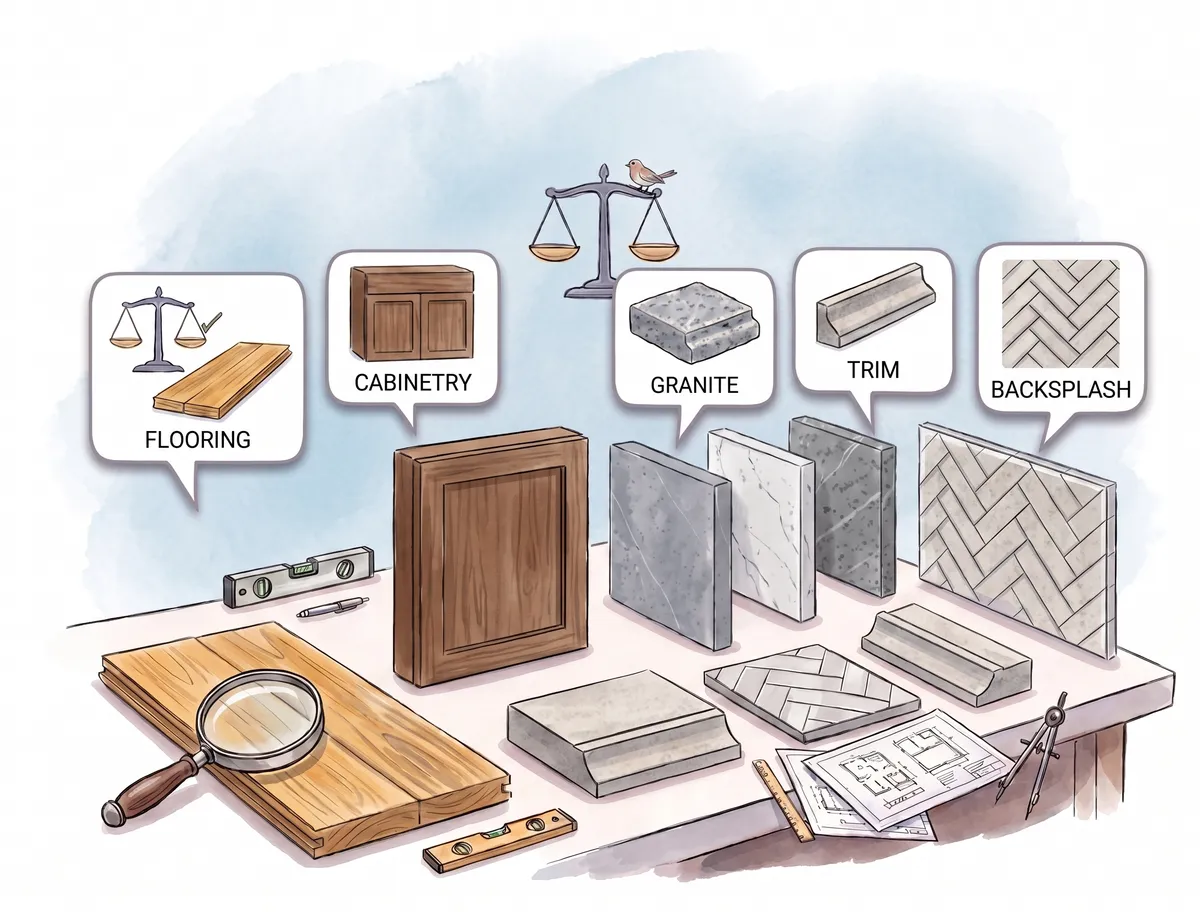
Your home's materials may be higher quality than what's reflected in a standard repair estimate. This section breaks down what's actually installed and what it costs to replace with the same quality.
This property features mid-to-premium grade finishes that significantly affect replacement costs:
- Flooring: Site-finished solid white oak, 5" wide plank, select grade. This is a premium specification — 2-3x the cost of pre-finished or engineered alternatives. The wider 5" plank commands a premium over standard 3.25" width. Site-finishing (sand, stain, 3 coats poly on-site) adds $4-6/sq ft over pre-finished installation.
- Cabinetry: Semi-custom grade with maple construction, dovetail drawer boxes, and Blum soft-close hardware. Stock cabinets from home improvement stores run $150-250/linear ft installed; this grade runs $450-800/linear ft. The island is a custom built-in with integrated plumbing and electrical, not a standalone furniture piece.
- Countertops: Level 3 granite with ogee edge profile across perimeter and island. Builder-grade granite (Level 1, eased edge) is $35-50/sq ft; this grade with premium edge is $65-110/sq ft. Two undermount sink cutouts add fabrication cost.
- Trim: Stain-grade solid oak baseboards and crown molding (not paint-grade MDF). Stain-grade materials are 2-3x the cost of paint-grade alternatives and require skilled finishing.
- Backsplash: Herringbone pattern subway tile with accent strip. Pattern labor is 40-60% more expensive than standard running bond installation.
All replacement materials should match these installed quality levels. Substituting lower-grade materials does not meet like-kind-and-quality replacement standards.
Why More May Need Replacing
When part of a room is repaired, the new materials often don't match the rest. Most insurance policies require everything to look the way it did before the damage, which can mean replacing more than just the damaged area.
Four significant matching requirements affect the scope of this repair:
1. Hardwood Flooring (Kitchen + Dining Room): The white oak flooring is continuous through the kitchen (300 sq ft) and dining room (200 sq ft) in an open floor plan with no transition strips. Replacing only the kitchen flooring creates a visible seam where new and old finishes meet. Industry standard for site-finished hardwood is to replace or refinish the entire continuous area (500 sq ft total).
2. Kitchen Cabinetry (Uppers + Lowers + Island): If the lower cabinets are from a manufacturer or in a finish that has been discontinued, matching individual cabinets is not possible. The entire kitchen cabinet set (uppers, lowers, and island) must be replaced for visual consistency. This is the single largest matching consideration in this claim.
3. Paint (Kitchen + Dining Room): In an open floor plan, newly painted kitchen walls will not match adjacent dining room walls due to age, UV exposure, and paint batch differences. Full painting of both connected rooms is standard practice.
4. Crown Molding: Crown molding removed during cabinet replacement frequently cannot be reused without splitting or damage. Full kitchen crown replacement may require dining room crown replacement to match at the transition point.
Required Code Upgrades
When walls, floors, or wiring are opened up for repairs, current building codes may require upgrades. Your insurance policy typically covers these required upgrades, but they're often left out of the initial estimate.
Several building code requirements apply to this kitchen remodel scope:
1. GFCI Protection (NEC 210.8): All kitchen receptacles serving countertop surfaces must have GFCI protection. Any receptacles exposed during the remodel that lack GFCI must be upgraded. The island requires a dedicated 20-amp circuit.
2. Dedicated Kitchen Circuits (NEC 210.11): Kitchen requires minimum two 20-amp small appliance branch circuits. If existing wiring is disturbed, it must meet current code requirements.
3. Plumbing Shut-Off Valves: Failed supply line replacement requires quarter-turn shut-off valves and braided stainless supply lines per current code. Both hot and cold lines should be replaced, not just the failed line.
4. Smoke/CO Detectors: If electrical permits are pulled, current code may require hardwired interconnected smoke and CO detectors throughout the home.
5. Ventilation: If the range hood is disconnected during construction, reinstallation must meet current ventilation code requirements (minimum 100 CFM for residential kitchens).
6. Gas Line (if applicable): Gas range disconnect/reconnect requires licensed plumber and gas pressure test. Flexible gas connectors may need to meet current standards.
Code upgrades triggered by the repair should be covered under the Ordinance or Law coverage provision of most homeowner's policies.
What Else You Should Know
Important things to know about this type of damage that can affect your repair timeline, costs, and what your policy covers.
Several considerations are commonly relevant for kitchen water damage of this type:
- Hidden Damage Under Cabinets: Kitchen leaks beneath sinks create conditions where water pools under cabinets, behind kick plates, and in wall cavities that are not visible without demolition. Exploratory demolition (removing kick plates, opening wall cavities behind sink area) is standard practice before finalizing scope.
- Timeline of Exposure: Slow leaks under kitchen sinks can go undetected for days or weeks. The longer the exposure, the more extensive the damage to subfloor, wall framing, and adjacent rooms. A slow leak that travels along the subfloor can damage the dining room before any visible signs appear in the kitchen.
- Appliance Warranty Impact: Water-damaged appliances (especially dishwashers and refrigerators with water/ice connections) may have voided warranties. Document appliance condition and model numbers before any work begins.
- Depreciation Recovery: If your settlement uses Actual Cash Value (ACV), depreciation has been applied. Most Replacement Cost Value (RCV) policies allow you to recover the depreciation holdback after repairs are completed at full replacement cost.
- Additional Living Expenses: A full kitchen remodel (6-8 weeks) means no cooking facilities. Most homeowner's policies include Additional Living Expense (ALE) coverage for reasonable costs of eating out or temporary kitchen setup during construction. Review your policy for ALE limits and requirements.
- Contractor Selection: For a project involving 8+ trades (demo, plumbing, electrical, drywall, cabinetry, countertop, flooring, tile, painting), a general contractor with insurance restoration experience is recommended over individual trade contractors.
Terms You May See in Your Estimate
- Replacement Cost Value (RCV)
- Your insurer pays the full cost to replace what was damaged with new materials of the same quality, with no deduction for age or wear.
- Actual Cash Value (ACV)
- The value of your damaged property minus depreciation. This is often the initial payout, with the rest paid after you complete repairs.
- Depreciation Holdback
- Money your insurer holds back from the first check. You can usually get this money back after repairs are finished by submitting receipts.
- Ordinance or Law Coverage
- A part of your policy that pays for bringing repairs up to current building codes. This is often missed in initial estimates.
- Like-Kind-and-Quality
- The rule that replacement materials must match what you originally had. If you have solid hardwood, they can't substitute laminate.
- Matching Requirement
- When damage is part of a larger surface (like flooring that runs through multiple rooms), the repair may need to extend beyond the damaged area so everything matches.
- Xactimate
- The software most insurance companies and contractors use to create repair estimates. Understanding how it works helps you read your estimate.
- Overhead and Profit (O&P)
- A standard markup (typically 20%) added when a project needs three or more different types of contractors. Insurers sometimes leave this out.
- Additional Living Expenses (ALE)
- When your home can't be lived in during repairs, your policy may cover reasonable extra costs like temporary housing and meals.
- Contents Pack-Out
- Professional removal, storage, and return of your belongings so construction work can be completed safely.
Important Information
- This is a property analysis and market pricing information service, not insurance, legal, or financial advice.
- This report does not create any representative, agent, or fiduciary relationship.
- Market pricing is general information based on regional construction cost data.
- Analysis is based solely on photos and information provided, not a physical inspection.
- The homeowner is responsible for all decisions regarding their property and any insurance matters.
- For professional representation, consult a licensed public adjuster. For legal questions, consult an attorney.
Ready to analyze your property?
Upload photos of your damage and get a detailed analysis like this.
Start My AnalysisFree to get started. Pay only when your report is ready.